It’s 2am on a sweltering Brisbane night, and your air conditioner just stopped working.
You’re lying there in a pool of sweat, desperately googling “emergency AC repair near me,” thinking: “I should’ve gotten it serviced.”
Here’s the truth most Brisbane homeowners don’t realize: regular AC maintenance isn’t just recommended—it’s essential for survival in our brutal summers. But how often should you actually schedule air conditioning maintenance? And what really happens if you skip it?
With Brisbane’s extreme heat, high humidity, and increasingly frequent heatwaves, your air conditioner works harder than units in almost any other Australian city. That means it needs more attention, not less. Miss your maintenance schedule, and you’re not just risking an expensive breakdown—you’re gambling with your family’s comfort and safety during 40°C days.
In this guide, you’ll discover exactly how often to service your AC based on your system type, usage patterns, and Brisbane’s unique climate—plus the warning signs that mean you need maintenance right now.
Because the best time to service your AC was last September. The second best time? Today.
The Quick Answer: How Often AC Maintenance is Needed
Alright, let’s cut straight to what you came here for.
Air conditioners should be professionally serviced at least once per year, ideally in September or early October before Brisbane’s summer heat arrives. But that’s just the baseline—your specific maintenance schedule depends on a few different factors.
Standard Maintenance Schedule:
Residential split systems: Once per year (before summer kicks in)
Get it done in September or October, right before the heat hits. This is your standard ducted or wall-mounted split system that most Brisbane homes have.
Ducted air conditioning: Once per year (pre-summer service)
Same deal as split systems. Book it early spring, enjoy reliable cooling all summer.
Commercial systems: Every 6 months (higher usage demands more frequent service)
If you’re running your AC in a shop, office, or business where it’s on 8+ hours daily, you need twice-yearly servicing.
Heavily used systems: Every 6-9 months (homes running AC daily year-round)
Work from home? Run your AC basically every day? Got someone home during the day who needs climate control? You’re in this category.
Brisbane-Specific Considerations:
Here’s what makes our city different from everywhere else in Australia.
| Climate Factor | Impact on Your AC | What This Means for Maintenance |
|---|---|---|
| High Humidity (70-90%) | Accelerates wear, promotes mold growth | More frequent filter checks, drainage line attention |
| Extreme Temps (38-41°C) | Components work at maximum capacity | Annual service non-negotiable, watch for strain |
| Storm Season Debris | Blocks airflow, damages outdoor units | Post-storm inspections, clear debris regularly |
| Coastal Salt Air | Increases corrosion on metal components | Anti-corrosion treatments, more frequent checks near coast |
⚡ Quick Rule: If your electricity bill suddenly spikes or your AC isn't cooling as efficiently, schedule maintenance immediately—don't wait for your annual service. Something's wrong, and waiting will only make it more expensive to fix.
Why AC Maintenance Frequency Matters in Brisbane
Brisbane’s Climate Puts Extra Stress on Your AC Unit
Your air conditioner isn’t just cooling your home—it’s battling Brisbane’s notoriously challenging climate conditions every single day.
We’re dealing with an average of 150+ days above 25°C annually. Humidity levels sit between 70-90% year-round. Here’s a surprising data point: AC units in Brisbane work 40% harder than Sydney units due to humidity alone.
According to Bureau of Meteorology data, Brisbane experiences an average of 64 days above 30°C annually—more than three times the frequency of Sydney or Melbourne.
This extended heat exposure means your system doesn’t get the “rest periods” that units in cooler climates enjoy. Your Brisbane unit works from October through April at minimum—that’s seven months of consistent heavy use.
Brisbane’s high humidity accelerates wear on your AC components. Moisture promotes mold growth in ductwork and filters. It corrodes electrical connections faster. And it puts constant strain on your compressor as it works overtime to remove humidity from the air, not just cool it.
The Real Cost of Skipping Regular Maintenance
Let’s talk about what happens when you skip maintenance.
Unmaintained AC units lose 15-25% efficiency annually, translating to hundreds of extra dollars on power bills. Dirty filters, clogged coils, and worn components force your system to run longer to achieve the same cooling.
Lifespan Impact:
- Well-maintained AC: 12-15 years
- Neglected AC: 8-10 years
You’re throwing away years of equipment life by skipping service.
Over 10 years, homeowners who skip annual maintenance spend thousands more than those who maintain their systems regularly—not counting the misery of emergency breakdowns during 40°C heatwaves.
One midnight AC failure during a January heatwave. Kids crying, no one sleeping, desperately calling emergency services at 2am. Is skipping one annual service worth that risk?
📖 REAL STORY: The Thompson Family, Indooroopilly
The Situation:
The Thompsons skipped their annual AC service for three years straight to “save money.” They figured if it wasn’t broken, why fix it? Their ducted system seemed fine—cooling reasonably well, no weird noises, nothing obviously wrong.
Then January 2024 brought five consecutive days above 38°C.
What Happened:
Day 3 of the heatwave: Their AC stopped cooling properly. It was running constantly, but the house temperature wouldn’t drop below 28°C. Their electricity bill that month? Nearly triple their normal summer bill.
They called for emergency service. We found:
- Completely clogged air filters (hadn’t been changed in 2+ years)
- Refrigerant leak that had been slowly draining the system
- Compressor working overtime to compensate, causing premature wear
- Mold growth throughout the ductwork from Brisbane’s humidity
💡 The Lesson: If they'd maintained it annually, we would've caught that refrigerant leak when it was small, kept their filters clean, and prevented the mold growth. Instead, one emergency turned into a nightmare—plus the stress, the sleepless nights, and their kids being miserable during the heatwave.
Standard Maintenance Schedule by System Type
Not all air conditioners are created equal. Let’s break down exactly how often AC maintenance is needed for each type.
Split System Air Conditioners (Most Common in Brisbane Homes)
Recommended Service Frequency: Once per year, September-October
Wall-mounted units with outdoor compressor boxes are the most common in Brisbane homes and pretty reliable if treated right.
Annual service includes:
- Filter cleaning/replacement
- Refrigerant level check
- Coil cleaning (indoor and outdoor)
- Drainage line clearing
- Electrical connection inspection
- Thermostat calibration check
Best timing: September or early October, before the real heat hits.
Red flag: If you’re running your AC 8+ hours daily (work from home, medical needs), service every 8-9 months.
Ducted Air Conditioning Systems
Recommended Service Frequency: Once per year, September-October
Ducted systems cool your whole house but have more components that can go wrong.
Your ductwork runs through your roof cavity where temperatures hit 60-70°C in summer—that extreme heat stresses duct seals and insulation. With air flowing through multiple vents, dust and debris accumulate faster. One blocked return vent can reduce efficiency by 20%.
Brisbane concern: After storm season, consider a post-storm inspection. Branches can punch holes in outdoor units and debris can block compressor airflow.
Multi-Head Split Systems & Commercial Systems
Multi-head systems: Once per year. Multiple indoor units need all filters and coils serviced during the same visit. Don’t try to save money by servicing only “the problem” unit—they all share the same outdoor compressor.
Commercial systems: Every 6 months minimum. Running 10-12 hours daily with high foot traffic means twice the maintenance frequency of residential.
The Pre-Summer Service Timing (This is Where Most People Get it Wrong)
Here’s what I see every single year: homeowners call for AC maintenance in November or December, right when everyone else is calling.
The problem with waiting:
By late November, every AC technician in Brisbane is booked 1-2 weeks out with emergency repairs. Your “routine maintenance” request goes to the bottom of the priority list because people with completely broken systems need help first.
⭐ Pro tip from the field: Set a recurring phone reminder for September 1st every year. When it goes off, book your service that same day. Make it automatic, like paying your car registration. Future you will thank present you.

Warning Signs You Need Service Now
Sometimes your AC tells you it needs help right now. Missing these warning signs can turn a small repair into a major replacement.
AC Warning Signs & Response Guide
| Warning Sign | What It Means | Urgency Level | What To Do |
|---|---|---|---|
| Not Cooling Properly | Refrigerant leak, dirty coils, blocked unit | Medium | Call within 2-3 days |
| Grinding/Squealing Noise | Belt or bearing issue | High | Stop using, call today |
| Banging/Clanking | Loose components, failing compressor | High | Stop using, call today |
| Hissing/Bubbling Sound | Refrigerant leak | High | Stop using, call today |
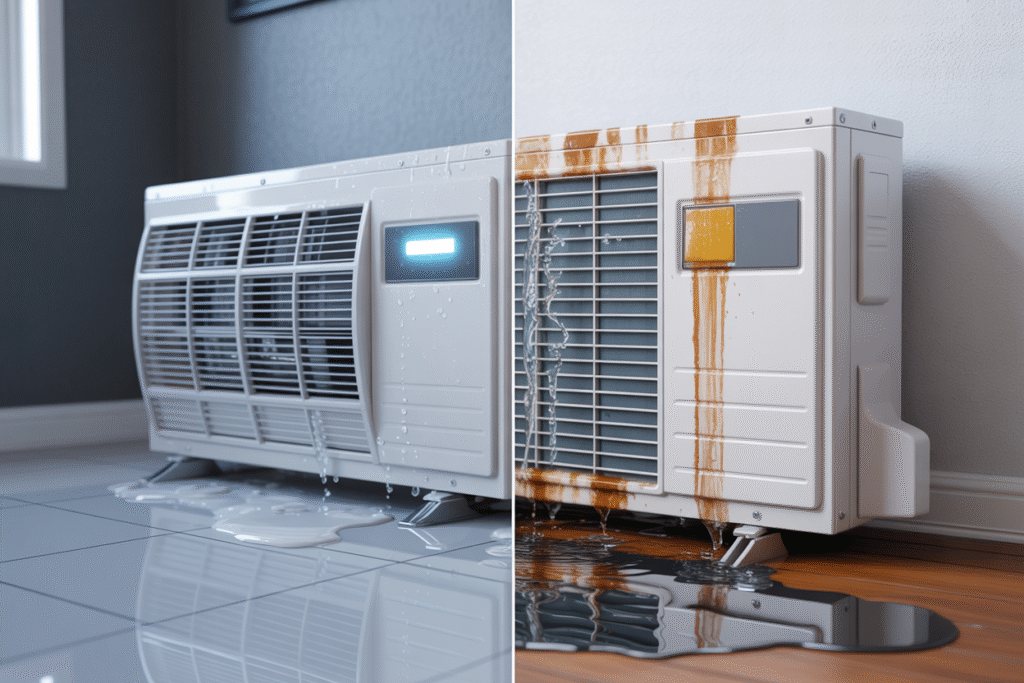
| Water Leaking | Blocked drain line (common in Brisbane) | High | Turn off, call same day |
| Bills Suddenly Spike | System running inefficiently | Medium | Book service soon |
| Musty/Moldy Smell | Mold in ductwork or coils | Medium | Service within a week |
| Burning Smell | Electrical issue or dust on coils | URGENT | Turn off immediately, call now |
| Chemical Smell | Possible refrigerant leak | High | Turn off, call today |
Your AC is Running But Not Cooling Properly
What it looks like: Thermostat set to 22°C, house sitting at 26-27°C. Unit running constantly but not cooling.
Probable cause: Refrigerant leak, dirty coils, blocked outdoor unit, or failing compressor.
What to do: Call for service within a few days.
Strange Noises
Grinding/squealing: Belt or bearing issue
Banging/clanking: Loose components or failing compressor
Hissing/bubbling: Refrigerant leak
Constant clicking: Electrical issue or failing relay
A customer in Coorparoo ignored grinding noise for three weeks. The failing bearing damaged the motor shaft, turning a simple repair into major motor replacement.
What to do: Don’t run the unit until checked. Call today.
Water Leaking From Indoor Unit
Cause: Blocked condensate drain line. Brisbane’s humid climate promotes algae and mold growth that blocks the drain pipe.
What to do: Turn off and call same day. Usually a quick fix if caught early.
Electricity Bills Suddenly Spike
Compare this summer to last summer. Sudden jumps mean your AC is working inefficiently.
Unpleasant Smells
Musty/moldy: Mold in ductwork or coils (common in Brisbane)
Burning: Electrical issue or dust on coils—turn off immediately
Chemical: Possible refrigerant leak
Wrapping This Up: Your Next Steps
Look, we’ve covered a lot of ground here. So let me boil this down to what actually matters.
The bottom line is simple:
Your AC needs professional service once a year, ideally in September or early October. That’s it. That’s the baseline that’ll keep your family comfortable, save you money, and prevent those middle-of-the-night panic moments during heatwaves.
Here’s what happens when you actually do this:
You’ll sleep better in summer knowing your AC won’t die during the next heatwave. Your power bills will be lower because your system runs efficiently. You’ll avoid emergency repair bills that always seem to hit at the worst possible time. And your AC will last 12-15 years instead of limping along for 8 and dying when you can least afford to replace it.
The decision you’re facing right now:
You can close this tab, think “yeah, I should probably do that,” and then forget about it until December when it’s too late and every tech in Brisbane is booked solid.
Or you can take 5 minutes right now—literally right now while you’re thinking about it—and book your service for September.
Five minutes today saves you hundreds (maybe thousands) of dollars and countless hours of stress later.
One last thing:
Every single customer who’s called us with a catastrophic AC failure during a heatwave—every single one—has said the same thing: “I kept meaning to get it serviced, I just never got around to it.”
Don’t be that person.
Your future self, sweating through a 40°C January night because your unmaintained AC just died, will either thank you or curse you for the decision you make today.
Brisbane summers are brutal. Your AC is what stands between your family and serious discomfort, possibly even health risks for kids or elderly relatives.
Treat it like the essential equipment it is.
Get it serviced. Stay cool. Sleep well.
Don’t wait until it’s too late. Book your service today and enjoy a worry-free Brisbane summer.
Ready to Book Your AC Service?
Professional air conditioner repairs and maintenance for Brisbane homes.
Same-day and next-day appointments available.
Frequently Asked Questions About AC Maintenance
Q.How often should I service my air conditioner in Brisbane?
Most residential split and ducted systems need professional service once per year, ideally in September or October before summer. However, if you're running your AC 8+ hours daily (work from home, medical needs), bump it up to every 6-9 months. Commercial systems need servicing every 6 months due to heavier use.
Q.What happens during a professional AC service?
A proper service includes filter cleaning/replacement, refrigerant level checks, coil cleaning (indoor and outdoor), drainage line clearing, electrical connection inspection, and thermostat calibration. For ducted systems, technicians also check ductwork, zone motors, and multiple vents. The whole process typically takes 45-90 minutes depending on your system type.
Q.My AC seems to be working fine. Do I really need service?
Yes. Your AC can appear to work fine while running 30% less efficiently, slowly leaking refrigerant, growing mold, or developing electrical issues. By the time you notice problems, damage is already done. Regular maintenance catches issues early before they become expensive emergencies. 87% of emergency AC failures could have been prevented with proper maintenance.
Q.My AC unit is over 10 years old. Should I still maintain it or just replace it?
If it's working well, absolutely maintain it. A well-maintained 12-year-old unit can give you another 3-5 years of reliable service. However, if you're facing major repairs or it's needed multiple fixes in the past 2 years, replacement might make more sense. Ask your technician straight up: "Would you repair or replace this?" Most will give you honest advice.
Q.Do new AC units need maintenance right away?
Yes! Most manufacturers require proof of annual professional maintenance to keep your warranty valid. Skip your year-two service, and when something fails in year three, you'll pay out of pocket for what should have been a free warranty repair. Plus, new systems need installation debris cleaned out and first-year checks.
Q.What if I can't remember when I last had my AC serviced?
If you can't remember, it's been too long. Book a service now. Then set up a system to remember: phone reminders, link it to another annual task (like tax prep or car registration), or use your AC company's reminder service. Many companies will automatically text or call you each September.
Q.Does Brisbane's climate really make that much difference for maintenance?
Absolutely. Brisbane's humidity (70-90% year-round) and extended heat (7 months of heavy AC use) means your unit works significantly harder than systems in Sydney or Melbourne. We experience 64 days above 30°C annually—more than triple Sydney's frequency. Our AC units need more attention, not less.
Q.Can skipping one year of maintenance really cause that much damage?
Yes. One skipped year allows problems to compound. A small refrigerant leak becomes a major leak. Dirty coils force your compressor to work harder, shortening its life. Blocked drainage causes water damage. Mold growth spreads. What could have been caught as minor issues become expensive repairs or premature replacement.
Q.What are the warning signs I need service immediately, not at my scheduled time?
Call within days: Poor cooling, high electricity bills, musty smells
Call today: Strange grinding/banging noises, water leaking, hissing sounds, chemical smells
Turn off and call immediately: Burning smell, smoke, or sparks
Don't ignore warning signs hoping they'll go away. They won't.