
You’ve just booked your annual AC service, and the technician spent 20 minutes at your Brisbane home before declaring everything “looks good.” But three weeks later, during the first 38°C heatwave, your air conditioner stops cooling. Now you’re facing an emergency repair that could have been prevented.
Sound familiar? You’re not alone. Thousands of Brisbane families go through this nightmare every summer because they didn’t know what a proper AC service should actually include. And honestly, that’s not your fault – most AC companies don’t want you to know the difference between a thorough service and a quick cash grab.
A proper AC servicing checklist isn’t just about ticking boxes. It’s about protecting your family’s comfort and your wallet from Brisbane’s brutal summer heat. This guide reveals exactly what a thorough air conditioning service should include, so you can hold your technician accountable and spot when someone’s cutting corners.
In this guide, you’ll discover the critical checkpoints every AC service must include, warning signs your technician is rushing through the job, questions to ask before they leave, and how proper servicing can slash your electricity bills while extending your unit’s lifespan by years. Whether you have a split system or ducted air conditioning, this checklist ensures you’re getting the professional service your Brisbane home deserves.
Why Your AC Service Checklist Actually Matters
Let me be straight with you – most Brisbane homeowners have no idea what their AC technician is actually doing during a service. You trust everything’s been checked properly. But here’s what you need to know: not all AC services are created equal, and the difference between a thorough service and a rushed one could cost you thousands down the track.
What a Comprehensive Service Prevents
Brisbane’s climate is absolutely brutal on air conditioners. We’ve got humidity sitting at 70-85% most of summer, salt air if you’re anywhere near the coast, and storm season dumping debris on outdoor units. Your AC works 40% harder here than it would in Melbourne or Sydney – that’s just the reality of living in Brisbane.
A thorough service catches problems before they become disasters:
Refrigerant leaks – Small leaks waste hundreds on electricity and eventually kill your compressor. Caught early during a proper pressure test? Minor fix. Left until your AC stops working completely? Major replacement.
Electrical failures – Loose connections cause fires. Not trying to scare you, but this is serious stuff. A good technician tests every electrical connection and tightens anything that’s come loose from vibration. Takes an extra 10 minutes that could literally save your home.
Drainage blockages – Brisbane’s humidity means your AC pulls litres of water out of the air every day. When that drain line blocks up (and it will, especially with our algae-friendly climate), you’re looking at water damage through your ceiling or walls. We’re talking insurance claims, ceiling repairs, mold remediation. All prevented by proper drain maintenance.
Mold growth – This is huge in Brisbane. The combination of moisture and warmth inside your AC creates the perfect environment for mold. If your technician isn’t actually opening up the unit and checking the evaporator coil, they’re missing black mold that’s being blown through your house every time the AC runs. Not great for anyone’s health, especially kids with asthma.
The Complete Pre-Service Preparation Checklist
What you do BEFORE the technician arrives can make a massive difference in the quality of service you get. A bit of prep work on your end means they can focus on actually servicing your AC.
Clear the area around your units. Your technician needs easy access to both the indoor and outdoor components. Move furniture, storage boxes, or kids’ toys away from wall-mounted units (at least 1 metre clearance). Trim back any plants around your outdoor condenser – you want 50cm clear space on all sides.
Gather your AC history. Dig out any paperwork from previous services. Grab your last 3-4 electricity bills. Write down any weird behaviour you’ve noticed: strange noises, water dripping, rooms that won’t cool.
Take photos of visible problems. Got water staining near the indoor unit? Rust on the outdoor unit? Ice building up on the pipes? Snap photos before the appointment.
Indoor Unit Service Checklist (8 Critical Checks)
Your indoor unit has a bunch of components that need regular attention. Problem is, they’re mostly hidden behind covers, which makes it really easy for lazy technicians to skip stuff.
✓ Check #1: Air Filter Condition
Your air filter is literally the first line of defense for your entire AC system. A proper tech will remove the filter and hold it up to the light. If you can’t see light through it, it’s blocked.
Why it matters: A dirty filter increases your energy consumption by 15%. Plus, when dust bypasses the filter, it coats your evaporator coil, which then needs expensive professional cleaning.
Red flag: If your technician doesn’t even remove the filter to inspect it, they’re not doing a real service.
✓ Check #2: Evaporator Coil Cleaning
Brisbane’s 75-85% humidity creates the perfect environment for mold growth on these coils. Every time your AC runs, it’s blowing that mold through your house.
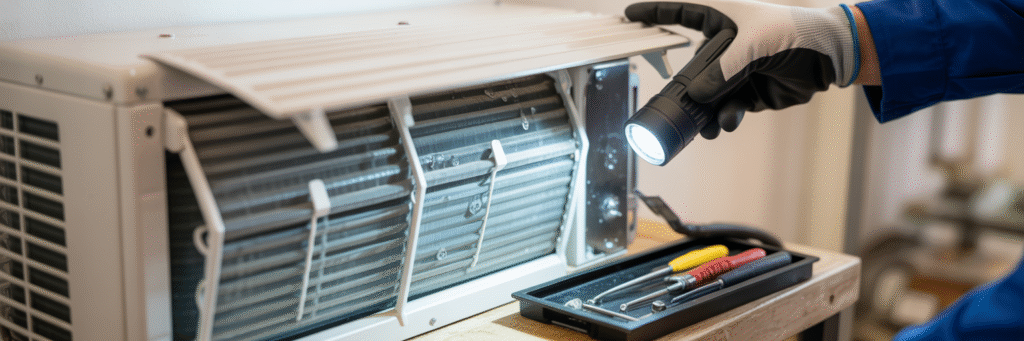
What should happen: They need to remove the front cover and actually inspect the coil with a torch. Use a specialized coil cleaner to chemically break down the grime. The drainage should run clear when they’re done.
Red flag: If they claim they can tell the coil is clean without removing the cover, they’re lying to you.
⚠️ CRITICAL WARNING: You physically CANNOT assess coil condition without opening the unit. If your technician says "looks fine through the grille" without removing any panels, they haven't actually checked anything. This is the #1 corner-cutting technique dodgy operators use.
✓ Check #3: Condensate Drain Line
In Brisbane’s humidity, your AC pulls multiple litres of water out of the air every single day. When that line blocks, you’ve got water backing up into your home.
What should happen: The technician should trace the drain line from the indoor unit to where it drains outside. Flush the drain line with either a specialized treatment or a vinegar solution to kill algae. They should physically check that water drains quickly.
Ask them to show you where the drain exits outside. You should see water dripping when the AC’s been running.
✓ Check #4: Thermostat Calibration
A proper tech will use a separate thermometer to check actual room temperature against what your thermostat displays. They should be within 1 degree of each other.
Why it matters: A thermostat that reads 2-3 degrees off can cost you hundreds per year in wasted electricity.
✓ Check #5: Electrical Connections – Indoor
Electrical connections vibrate loose over time, wires corrode in Brisbane’s humidity, and loose connections can start fires.
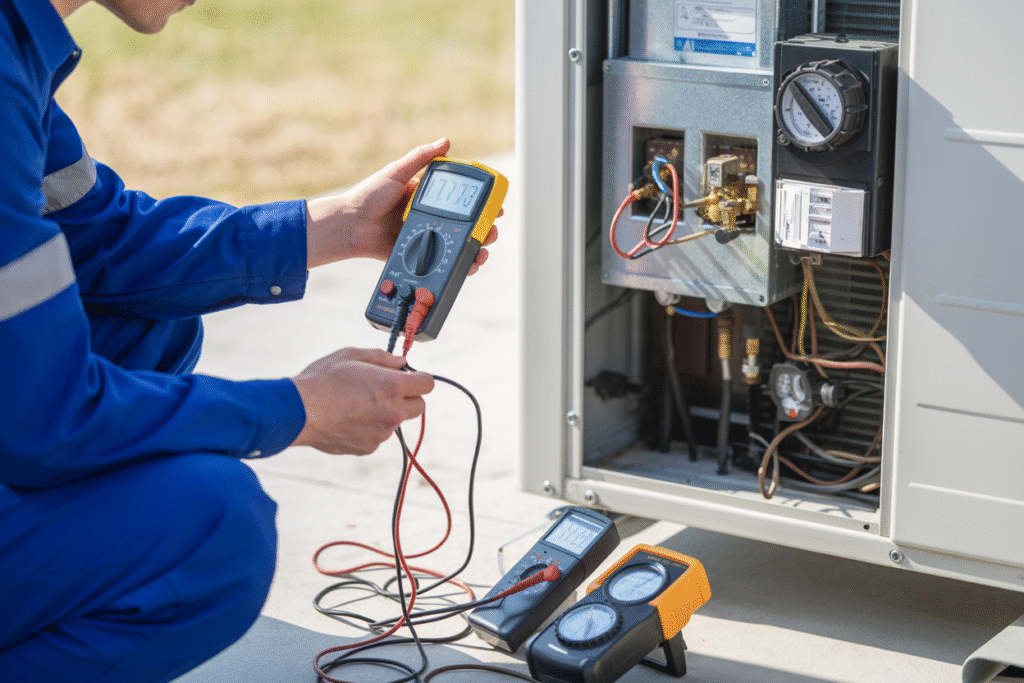
What should happen: They should be using a multimeter to test voltage at various connection points. They should physically check that all wire connections are tight, looking for any signs of arcing, corrosion, or damaged insulation.
✓ Check #6: Blower Motor and Fan
The blower motor pushes air through your system. If it’s struggling, you’ll notice reduced airflow, strange noises, or rooms that won’t cool properly.
What should happen: Lubricate the motor bearings if needed, check the fan blades for damage or imbalance, test the capacitor, and check belt tension if your system uses belts.
✓ Check #7: Refrigerant Line Insulation
Those copper pipes connecting your indoor and outdoor units should be covered in foam insulation. In Brisbane, exposed pipes sweat like crazy due to humidity.
What should happen: Replace any damaged or missing insulation, seal gaps with appropriate tape, and check that the insulation is the right thickness.
✓ Check #8: Return Air Vents (Ducted Systems)
If you’ve got ducted air conditioning, return air vents pull air back into the system for cooling. Block these vents, and your whole system struggles.
What should happen: Clean all return air vents, check that they’re not blocked by furniture or curtains, test airflow with their hand or a gauge.
Outdoor Unit Service Checklist (7 Critical Checks)
Your outdoor unit contains the expensive stuff. This is where most expensive failures happen.
✓ Check #9: Condenser Coil Cleaning
When it’s caked in dirt, pollen, grass clippings, and Brisbane’s famous cottonwood fluff, it can’t release heat efficiently.
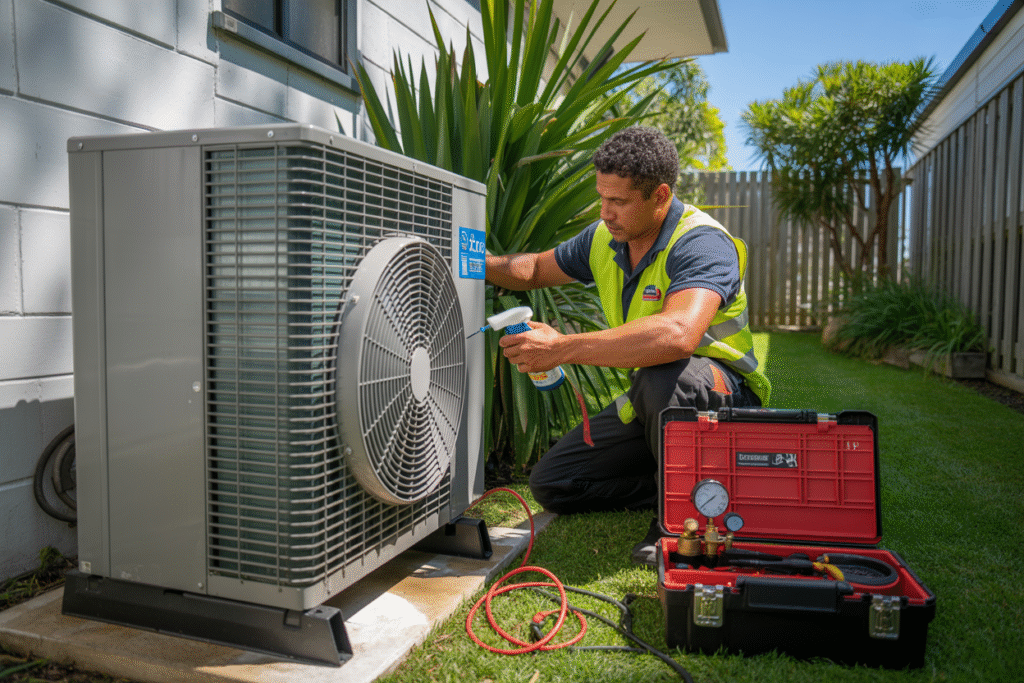
What should happen: Use a specialized coil cleaner and either a gentle spray or brush to clean the fins. They should NOT use a high-pressure hose – that bends the fins and makes things worse.
For Brisbane homes near the coast, ask about anti-corrosion treatments. Salt air eats aluminum coils.
✓ Check #10: Compressor Inspection
The compressor is the heart of your AC system. When it dies, you’re looking at major replacement.
What should happen: They should listen to the compressor running, check for abnormal vibration, measure the amp draw (how much electrical current it’s using), and test the starting capacitor.
✓ Check #11: Refrigerant Pressure Testing
Refrigerant is the stuff that actually makes your AC cool. Your system is charged with a specific amount at installation, and that amount should stay constant for the life of the system. If levels are low, you’ve got a leak somewhere.
What should happen: They should attach pressure gauges to the service ports and check both the high and low pressure sides. If levels are low, use leak detection methods to find the source.
Red flag: If they say “yeah, I topped up your gas” without telling you WHERE the leak was or fixing it, run. That’s a band-aid fix that’ll fail again soon.
Proper fix: Find leak → Fix leak → Recharge system Dodgy fix: Just add more gas (you’ll be low again in 6 months)
If your tech just “tops up” without leak detection, you’re being set up for repeat visits.
🚨 REFRIGERANT RED FLAG: Refrigerant doesn't get "used up" like petrol. It's a closed system. If levels are low, there's a LEAK.
✓ Check #12: Capacitor and Contactor Testing
These components fail regularly in Brisbane’s heat – and when they do, your AC stops working.
What should happen: Use a capacitor tester to check if the capacitor is holding the correct charge. Inspect contactors for pitting or burning.
✓ Check #13: Fan Motor and Blade Inspection
Your outdoor fan pulls air through the condenser coil to release heat. If this fan isn’t working properly, your entire system overheats and shuts down.
What should happen: Check that the fan spins freely by hand (with power off), test the motor capacitor, inspect blades for damage, tighten any loose mounting bolts, and listen for bearing noise when running.
✓ Check #14: Electrical Connections – Outdoor
Outdoor connections have the added fun of Brisbane’s humidity, storms, and temperature extremes.
What should happen: Tighten all terminals, test voltage at key points, spray contact cleaner on terminals, and check the disconnect box. Watch for ant nests – seriously, ants LOVE the warmth of electrical connections.
✓ Check #15: Cabinet and Mounting Check
The outdoor unit cabinet and mounting protect your expensive components from Brisbane’s weather – storms, hail, sun, and occasional flooding.
What should happen: Check that the unit sits level, all panels are secure, drain holes are clear, and there’s no structural damage. You need at least 50cm around the unit for proper airflow.
System Performance Testing & Final Checks
Here’s what separates a proper service from a half-arsed one – they should actually TEST the system to prove it’s working properly.
Performance Testing Checklist
| Test | What Should Happen | Normal Range (Brisbane) | What It Proves |
|---|---|---|---|
| Temperature Drop (Delta T) | Measure supply vs return air temp | 10-14°C difference | System is cooling efficiently |
| Thermostat Accuracy | Compare to separate thermometer | Within ±1°C | Thermostat reading correctly |
| Amp Draw | Measure compressor electrical current | At or below rated amps | Compressor not overworking |
| System Cycling | Observe complete on/off cycle | Smooth start/stop, no stuttering | Controls working properly |
| Airflow | Check velocity at vents | 5-7 m/s at main vents | No blockages restricting flow |
✓ Check #16: Supply vs Return Air Temperature
For Brisbane conditions, you want to see a temperature drop of 10-14°C between return and supply air. This is the proof that your AC is actually working properly.
What should happen: Use a digital thermometer to measure both supply and return temperatures while the system is running. If the delta T is outside the normal range, they need to figure out why.
✓ Check #17: Written Report and Documentation
You should get a written report showing what was checked, what was found, what was fixed, and what needs attention in the future.
What to look for: Photos of key components before and after cleaning, test results (temperatures, pressures, amp draws), list of work performed, recommendations for future action, and technician’s signature and license number.
Red flag: If they don’t provide any documentation or just give you a handwritten receipt with no details, that’s not good enough.
Final Thoughts
Your air conditioner is probably the most used appliance in your Brisbane home between November and March. It’s what makes this city liveable during summer. It’s what lets your kids sleep at night during heatwaves. It’s what keeps your elderly parents safe when temperatures hit 40°C.
This AC servicing checklist isn’t about making you paranoid or turning you into an HVAC expert. It’s about giving you the knowledge to spot the difference between a proper service and someone doing the bare minimum.
Now you know what should actually happen during a service. You know the red flags. You know what to ask, what to check, and when to push back. That knowledge alone will save you hundreds – probably thousands – over the life of your AC system.
So book that service. Get it done properly. Ask the questions. Hold your technician accountable. And when summer hits and your AC is running perfectly while your neighbor’s is breaking down, you’ll know it’s because you invested in proper maintenance.
Your Brisbane summer self will thank you.
Ready to Book Your AC Service?
Professional air conditioner repairs and maintenance for Brisbane homes.
Same-day and next-day appointments available.
Frequently Asked Questions About AC Servicing in Brisbane
Q.What's the difference between an AC service and an AC repair?
A service is preventative maintenance - cleaning, inspecting, and testing to keep your system running properly and catch small problems before they become expensive ones (think car service). A repair is fixing something that's already broken or failing. Good servicing prevents most repairs, but skipping services means you'll end up with more expensive emergency repair callouts when things eventually break down.
Q.My AC seems to be working fine. Do I still need a service?
Yes, absolutely, because most AC problems develop gradually and aren't obvious until something fails completely - your AC might seem fine but actually have dirty coils making it work 20-30% harder, refrigerant slowly leaking and killing your compressor, drain lines partially blocked and weeks away from overflowing, loose electrical connections creating fire hazards, or mold growing on coils and being blown through your house. By the time your AC "seems" broken, you're usually looking at expensive repairs instead of preventative maintenance that catches problems while they're still cheap to fix.
Q.Will servicing really reduce my electricity bills?
Yes, if your system needs it - a well-maintained AC uses 15-25% less electricity than a dirty, neglected one because maintenance fixes dirty filters that restrict airflow (making your AC run longer), dirty coils that can't transfer heat efficiently (making the compressor work harder), low refrigerant that makes the system struggle, and blocked drains that cause intermittent shutdowns. If your AC hasn't been serviced in 2+ years, you're almost certainly wasting electricity, and a proper service usually pays for itself within one Brisbane summer through electricity savings alone.
Q.My last service was only 6 months ago. Why is my AC not cooling properly?
A few possibilities: the service wasn't done properly (if they were in and out in 20 minutes, they probably didn't actually check everything), something's failed since the service (capacitors can fail suddenly, refrigerant leaks can develop, storm damage happens), the problem was noted in your service report but you didn't action it, or it's not actually a problem (Brisbane's extreme heat can make even healthy ACs struggle on 40°C days). Call the company back - if they serviced it properly 6 months ago, they should be willing to check what's changed, but if they're evasive or try to charge you again immediately, that's a red flag about the original service quality.
Q.Is it normal for water to drip from my outdoor unit?
Yes, that's completely normal - your outdoor unit releases condensation, especially on humid Brisbane days, so water dripping from the bottom or pooling around the base is fine. What's NOT normal is water dripping from your indoor unit, water stains on ceiling or walls near the indoor unit, water pooling inside your house, or excessive amounts of water around the outdoor unit - indoor water leaks usually mean a blocked condensate drain line, so call someone immediately before it causes ceiling damage.
Q.Do I need to service my AC if I barely use it?
Yes, but maybe not as frequently - even AC units that sit idle have problems like dust accumulating on components, seals and gaskets drying out and cracking, refrigerant developing slow leaks, pests nesting in the unit, and mold growing in Brisbane's humidity even when the AC is off. If you genuinely only use your AC 20-30 days per year, annual servicing is probably enough, but if "barely use it" means "every day from November to March," that's not barely using it - that's standard Brisbane usage and needs regular servicing.
Q.My technician says I need a new system, but mine is only 10 years old. Is that normal?
Maybe, but get a second opinion - a well-maintained AC in Brisbane should last 12-15 years, so at 10 years old you might need some repairs but full replacement is a big call. Ask "What specifically is wrong with my current system?", "Can you show me the failed components?", "What would it cost to repair vs replace?", and "Is this a safety issue or an efficiency issue?" Some techs push replacements because they make more money on new systems than repairs, while others genuinely assess that repair costs don't make sense - if they're saying "it's old, just replace it" without showing you specific failed components or explaining exactly why it can't be repaired, get a second opinion from another company.
Lorem ipsum dolor sit amet, consectetur adipiscing elit. Ut elit tellus, luctus nec ullamcorper mattis, pulvinar dapibus leo.