

Brisbane’s sitting at 36°C with that thick, sticky 75% humidity. Your air conditioner just made this awful grinding noise… and then stopped cooling completely.
Everyone’s sweating. The kids can’t sleep. You’re frantically Googling “air conditioner not working” while stressing about that $200+ emergency callout fee you didn’t budget for.
Take a breath.
Before you call an emergency technician at midnight, there’s five simple things you can check in the next 3 minutes that might save you hundreds of dollars and get your AC working tonight. No tools needed. No technical knowledge required.
This is honest advice from licensed Brisbane AC technicians. We’d rather save you money on an unnecessary callout than make a quick buck off your panic.
What to Do When Your Air Conditioner Stops Working
Work through these five checks before calling for help:
Check your thermostat settings – Make sure it’s set to ‘cool’ mode and the temperature is at least 3°C below room temperature.
Inspect your circuit breaker – Look for tripped breakers in your electrical panel and reset if needed.
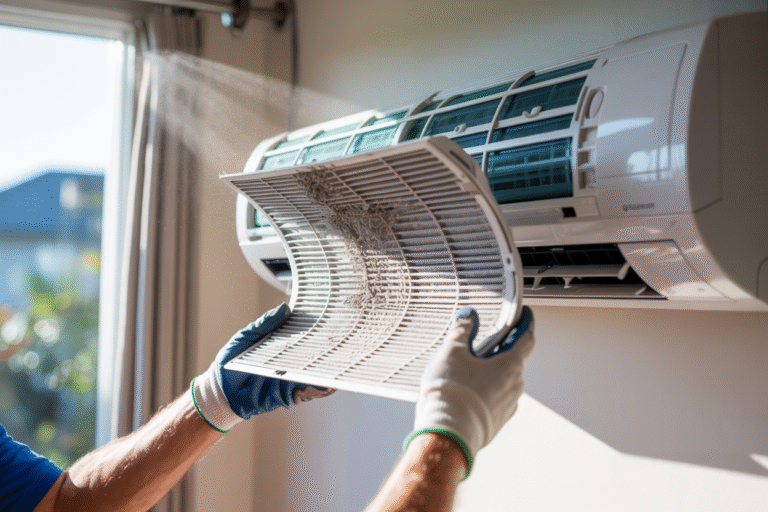
Replace or clean your air filter – This is the #1 cause of AC failure. A clogged filter triggers automatic shutoffs.
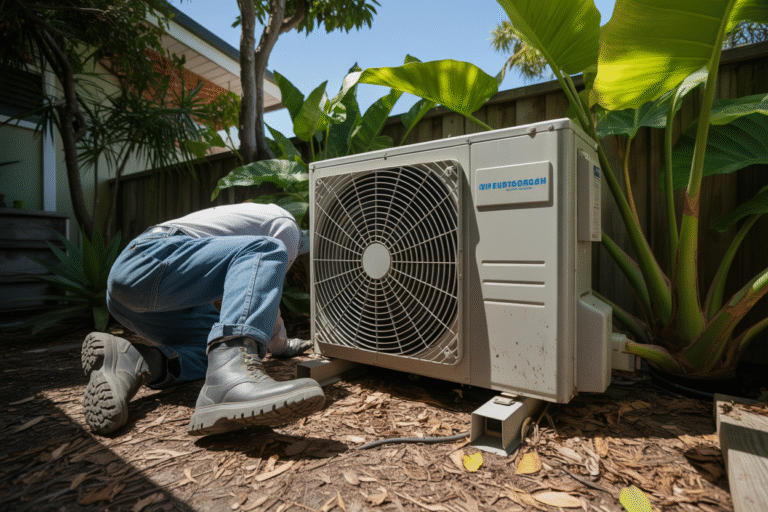
Check your outdoor unit – Remove debris, leaves, or obstructions blocking airflow around the condenser.
Verify power to outdoor unit – Find the disconnect switch near your outdoor unit and make sure it’s ‘on.’
If none of these steps restore cooling within 15 minutes, you’re dealing with a refrigerant leak, compressor failure, or electrical issue needing professional repair.
💡 Brisbane Pro Tip: 34% of all emergency AC calls we get are fixed by simply replacing a dirty air filter. Check this first before anything else.
First Things First: Is It Really Broken?
Sarah from Coorparoo called us at 11:30pm, convinced her AC was dead and needed a $2,500 replacement. Our dispatcher talked her through one check. Thirty seconds later, her AC was running perfectly. The problem? Her thermostat was set to ‘fan only’ instead of ‘cool.’
She’s not alone. You’re not alone either.
The #1 Mistake People Make
When your air conditioner’s not working at midnight and you’re stressed and sweaty, your brain goes straight to worst-case scenario. But sometimes “broken” just means “needs a small adjustment.”
Walk to your thermostat right now. Is it set to COOL? Is the target temperature at least 3 degrees lower than current room temp? Any error codes showing?
I’ve seen families spend $295 on emergency callouts when the issue was dead thermostat batteries.
Warning Signs vs. Normal Behavior
Normal AC behavior:
- Gentle humming when running
- Outdoor fan spins when cooling
- Cycles on/off every 10-20 minutes
- Drips water from condensation (outside)
Warning signs:
- Loud grinding or squealing noises
- Ice forming on indoor unit
- Water leaking inside your house
- Burning smell
- Circuit breaker trips repeatedly
- No air from vents
If you’re seeing normal behavior, we can probably fix this. If you’re seeing warning signs, we’ll need to be careful.
⚠️ SAFETY FIRST: If you smell burning, see sparks, or notice water leaking inside your home, turn off your AC at the circuit breaker immediately and call a professional. Don't try to troubleshoot electrical or water damage issues yourself.
The 5-Minute DIY Troubleshooting Checklist
Check #1: Your Circuit Breaker Box
Time: 30 seconds
Head to your electrical panel. Look for any switches in a different position than the others. They might be halfway between ‘on’ and ‘off.’
Look for breakers labeled “AC,” “Air Conditioner,” or “HVAC.”
Found one that’s tripped?
- Switch it fully to ‘off’ first
- Wait 10 seconds
- Flip it back to ‘on’
- Wait 3-5 minutes
- Check if your AC starts
If the breaker trips again immediately, STOP. That’s an electrical problem needing a licensed technician.
Check #2: The Air Filter
Time: 2 minutes
Here’s a stat that’ll blow your mind: 34% of emergency AC calls are resolved by simply replacing a dirty filter.
Your air filter is usually behind a return air vent, inside the indoor unit, or near the air handler. If you’ve got a split system, check the indoor wall unit.
Pull out your filter and hold it up to light. Can you see through it? If it looks like a solid grey mat of dust, that’s your problem.
A clogged filter starves your AC of airflow. The system overheats and shuts down to protect itself.
What to do:
Disposable filter? Throw it out and grab a new one from Bunnings for $8-$15.
Washable filter? Take it outside, spray it with the hose, let it dry completely (2-3 hours), then reinstall.
After replacing: Turn AC off at thermostat, wait 5 minutes, then turn back on. Give it 10 minutes to start cooling.
Michael from Ashgrove was about to pay our $295 after-hours fee when we asked him to check his filter first. It was completely clogged. Fifteen minutes later his AC was running perfectly, and he didn’t spend a cent.
Check #3: Outdoor Unit Inspection
Time: 2 minutes
Go outside and look at your condenser unit.
Check for:
- Is the fan spinning?
- Debris blocking the fins?
- Something fallen against it?
- Plant growth within 30cm?
Brisbane storms blow all sorts of rubbish around. I’ve seen units blocked by overgrown vines, garden pots, even trampolines that shifted in the wind.
Clear away anything blocking the unit. Give it 30cm clearance on all sides.
Safety warning: Don’t spray water into the unit while running. Don’t stick anything into the fan.
Check #4: Thermostat Batteries & Settings
Time: 2 minutes
If your thermostat display looks dim or blank, dead batteries are your problem. Pop it open, swap in fresh batteries, wait 30 seconds to reboot.
Double-check settings:
- Mode: COOL, not FAN or AUTO
- Temperature: 3°C below current room temp
- Fan: AUTO (not ON)
- No schedule overriding your settings
Smart thermostat? Check the app too. Kids playing with phones accidentally change settings all the time.
Check #5: Emergency Shutoff Switch
Time: 30 seconds
There’s usually a shutoff switch near your outdoor unit. Looks like a regular light switch, often in a weatherproof box.
Landscapers, kids, or family members accidentally flip this without realizing what it controls.
Walk around your outdoor unit. Make sure all switches are ‘on.’ There might also be one inside near your indoor unit.
Still not working? You've done everything safe and reasonable. What you're dealing with now needs professional diagnosis.
Red Flags: When to Stop and Call a Professional
There’s a line between smart troubleshooting and dangerous mistakes.
Electrical Issues (Don’t Risk It)
Stop immediately if you notice:
- Burning smell
- Scorch marks around connections
- Breaker keeps tripping repeatedly
- Sparks anywhere on the system
- Exposed wires
- Water near electrical components
Under Queensland electrical safety regulations, any 240V circuit work must be done by a licensed electrician. People have died doing electrical work without proper training.
Refrigerant Leaks (Health & Safety)
Signs of refrigerant leak:
- Ice on refrigerant lines
- Hissing or bubbling sounds
- AC runs but doesn’t cool
- Chemical smell (sweet or ether-like)
Handling refrigerant requires special licensing in Australia. You can’t legally buy it or handle it. Only licensed refrigerant handlers can work with it.
Mechanical Failures
These need professional help:
- Compressor failure
- Fan motor grinding
- Evaporator coil frozen solid
- Condensate drain completely clogged
- Any internal component replacement
DIY-Safe vs. Call Immediately
| ✅ You Can Safely Try This | ❌ Stop - Call Professional |
|---|---|
| Changing air filter | Any electrical repairs or wiring |
| Resetting circuit breaker once | Breaker trips repeatedly |
| Cleaning debris from outdoor unit | Opening sealed components |
| Replacing thermostat batteries | Adding refrigerant or fixing leaks |
| Checking shutoff switches | Repairing compressor or motors |
| Adjusting thermostat settings | Ice formation on refrigerant lines |
| Clearing visible drain blockages | Burning smells or sparks |
Understanding Brisbane AC Problems
Brisbane’s different. It’s not just heat—it’s extreme heat plus 70-90% humidity that turns your AC into a workhorse that never rests.
Why Brisbane’s Humidity Destroys AC Units
Your AC works twice as hard in humid conditions. It’s not just cooling air—it’s removing moisture. That moisture has to go somewhere, creating more potential for clogs and mold.
On 38°C days with high humidity, your AC might run 18-20 hours straight. That’s not what these systems were designed for.
Brisbane-specific problems:
- Condensate drain clogs
- Corroded electrical connections
- Mold growth in ductwork
- Compressors burning out from constant operation
The Age Factor
National average lifespan for AC systems is 15-20 years. In Brisbane? Cut that to 10-15 years.
AC units 10+ years old account for 68% of emergency breakdowns during heatwaves. Units under 5 years? Only 8%.
Storm Damage
January 2024 storms caused our phone to ring nonstop for three weeks.
Hail dents fins. Flying debris impacts fans. Lightning strikes fry circuit boards. Power surges when electricity comes back destroy components.
During that heatwave after the storms, our emergency calls increased 340%. We helped 127 families avoid callout fees through phone guidance.
You’re Gonna Be Okay
Your AC is broken, it’s hot, everyone’s miserable. But you’re handling it. You’re educating yourself. You’re making informed decisions instead of panic decisions.
If you got your AC working with these DIY checks—fantastic. You saved yourself $200+. Set that September reminder now.
If you still need help, that’s okay. Some problems genuinely require professional training and tools.
What to do next:
If your air conditioner’s still not working, give us a call. We’ll ask diagnostic questions over the phone—sometimes we solve it right there at no charge.
If you need someone to come out, we’ll give you honest timeframe and upfront pricing. No pressure. No surprises.
And if you call a different company? Just make sure they’re QBCC licensed, give written quotes before starting, and treat you with respect.
You’ve got this.
🎯 KEY TAKEAWAY: Most AC problems (34%) are caused by dirty filters. Check this first. If the five simple checks in this guide don't work, it's time to call a professional. Don't mess with electrical issues or refrigerant—that's dangerous and illegal without proper licensing.
Ready to Book Your AC Service?
Professional air conditioner repairs and maintenance for Brisbane homes.
Frequently Asked Questions
Q.Why is my air conditioner not working but the fan is running?
Your fan's running but no cold air means your compressor probably isn't working. This could be a tripped circuit breaker (check your electrical panel), a failed capacitor, or low refrigerant. Check the breaker first—if it's fine, you need a professional to diagnose the compressor or refrigerant issue.
Q.Why does my AC keep tripping the breaker?
Could be your system drawing too much power (sign of failing compressor), a short circuit, or electrical fault. Reset the breaker once. If it trips again immediately, STOP—that's a safety issue needing a licensed electrician or AC tech. Don't keep resetting it.
Q.What's the fastest way to cool down my house when AC is broken?
Close blinds/curtains on sun-facing windows, run ceiling fans, open windows at night when it's cooler outside, use portable fans, and stay hydrated. Move family to the coolest room in the house. If you've got elderly or very young kids and it's 35°C+, don't wait—call for emergency service.
Q.How often should I service my air conditioner in Brisbane?
Once a year before summer (September is perfect timing). Brisbane's humidity and constant summer use means your AC works harder than systems in cooler climates. Annual servicing catches small problems before they become $600+ emergency repairs and extends your system life by 5-7 years.
Q.Why is my AC running but not cooling the house?
Four common causes: dirty air filter (check this first!), low refrigerant (needs professional), outdoor unit blocked by debris, or failing compressor. If you've checked the filter and outdoor unit and it's still not cooling, you need a technician to check refrigerant levels and compressor function.
Q.Can I run my AC if it's leaking water inside?
Turn it off immediately. Water leaking inside usually means a clogged condensate drain or frozen evaporator coil. Running it can cause water damage to your ceiling, walls, and electrical components. Check if the condensate drain is clogged (you might be able to clear it), but if you're not comfortable doing that, call a professional.
Q.What's considered an AC emergency in Brisbane?
It's genuinely an emergency if: it's 38°C+ outside, you've got elderly family members or young children at home, someone has a medical condition affected by heat, or your house temperature is hitting 33°C+ inside. These are health and safety situations—we prioritize these calls over routine "AC not cooling as well" calls.